How to Choose an LED Display Screen for Your Hotel
Published 2026-08-10 · Updated 2026-09-14 · By Arclumin Team
Your hotel type, viewing distance and content decide the right LED display. This guide covers lobby, banquet and conference scenarios, plus LED chips, refresh rate and grayscale.
A Guide to Selecting the Right LED Display Screen for Your Hotel
As competition intensifies in the hotel industry, more and more hotels are turning to LED displays to enhance their ambiance and brand image.These range from lobby welcome screens to banquet hall backdrops. However, hotel settings differ from ordinary commercial advertising, demanding higher standards in display quality, stability, colour reproduction and overall aesthetics. So how should one choose an LED display screen for a hotel? Which parameters should you prioritize? In fact, this guide covers application scenarios, LED chips, key parameters and bracket material.
Clarify Your Hotel Application Scenario
Specifically, when hotels use LED displays, you should base the choice on the viewing distance, installation environment and content to be displayed.
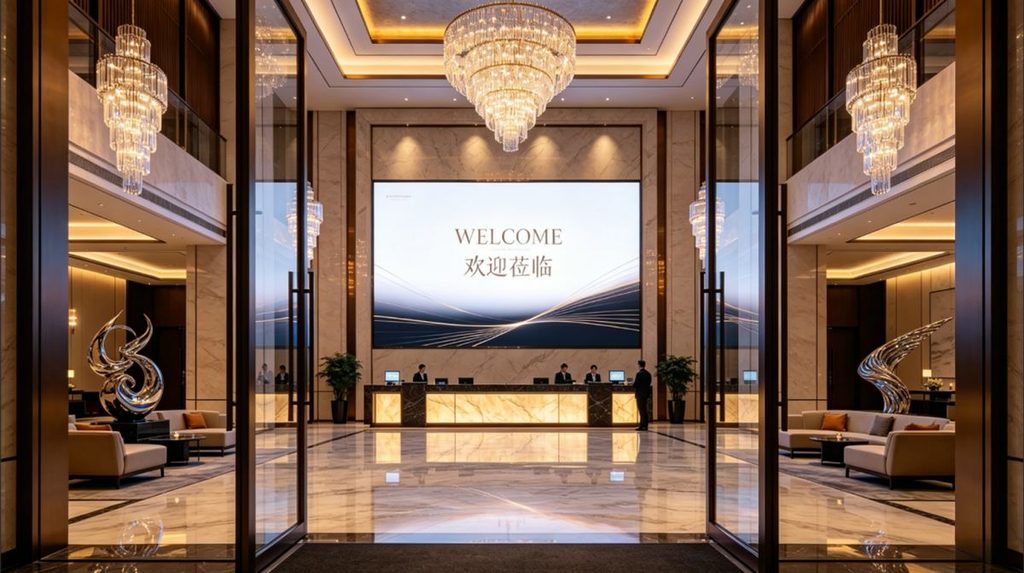
Hotel lobby LED display screen
The hotel lobby is the first visual area customers see upon entering the hotel. Operators usually use it to play hotel promotional videos, welcome messages, brand displays and other content. Because the viewing distance is relatively close, it is necessary to ensure the image detail and text display effect. As a result, we recommend choosing a small-pitch LED display screen.
Common recommendations:
– P1.25: Suitable for high-end star-rated hotels and close-up viewing areas.
– P1.5: Balancing display quality and cost control.
– P1.8: Suitable for larger lobby areas.
Small-pitch screens can reduce graininess, making hotel spaces more technological and upscale.
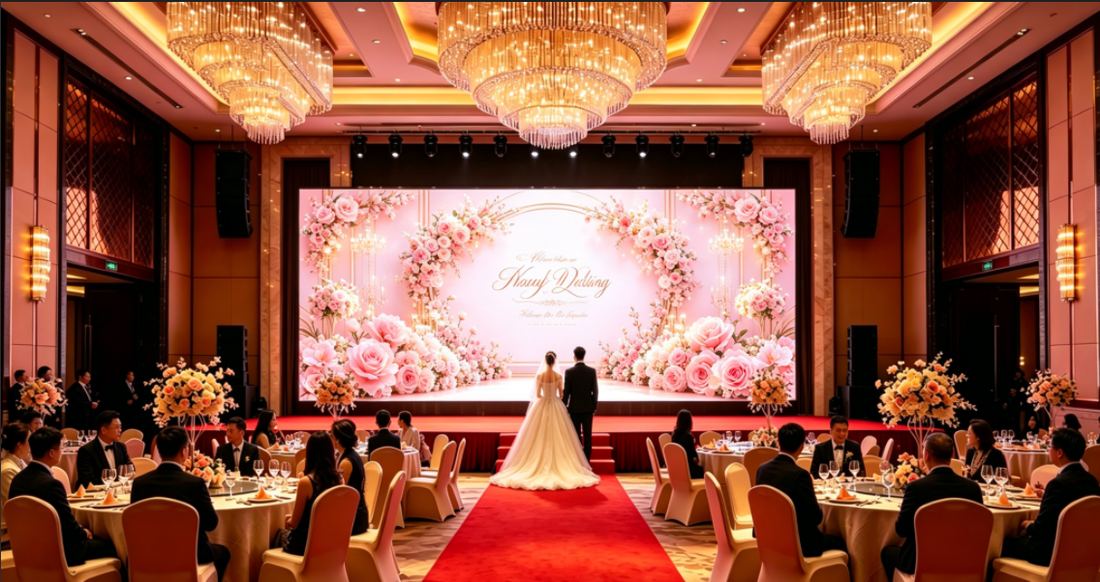
LED display screen in the hotel banquet hall
Banquet halls are typically used for events such as weddings, conferences and press conferences, and therefore require a high level of visual appeal. LED screens not only need to display high-definition images and videos, but also need to withstand different lighting environments, thus requiring high brightness, contrast and colour reproduction capabilities.
Common recommendation: P2.0
If the viewing distance in the banquet hall is around 3 to 8 meters, P2.5 is usually a more balanced choice.
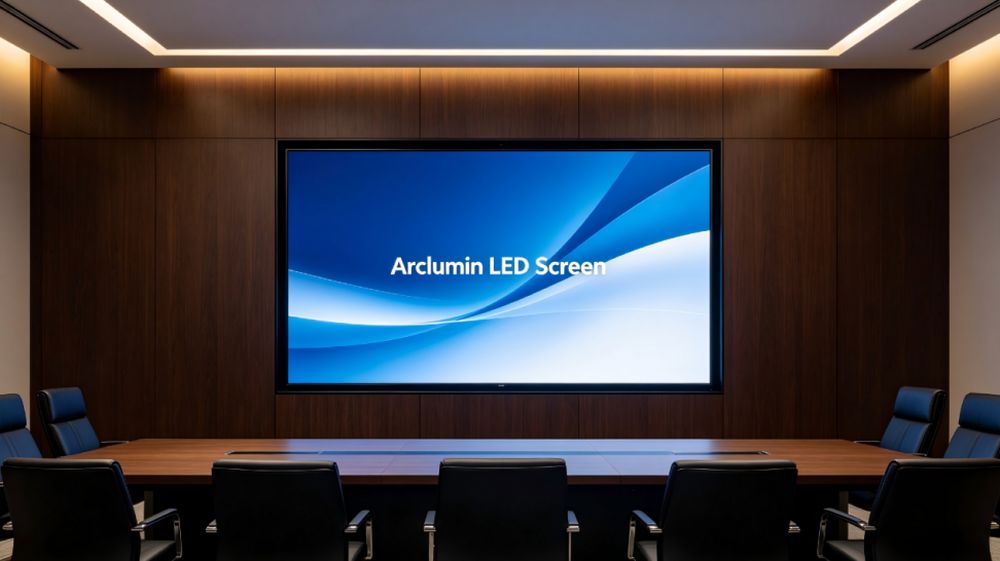
LED display screen in hotel conference rooms
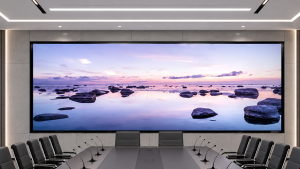
The conference room is mainly used for displaying meeting materials, video conferencing, corporate promotion and more, and has higher requirements for text clarity. Therefore, the commonly chosen values are P1.25, P1.5 and P1.8.
LED Chips: Why Quality Matters for Hotels
An LED display screen is composed of a large number of LED beads. Each bead is like a small pixel on the screen, responsible for emitting red, green and blue colours. Different colour combinations are used to present a complete picture. Simply put, in addition to the pixel pitch, the LED beads are also a very important factor in determining the quality of a screen display.
For applications like hotels, LED screens typically need to play hotel promotional videos, event footage and meeting content for extended periods, so the quality of the LED chips directly affects the screen performance. If the LED beads are of poor quality, problems such as inconsistent brightness and colour deviation may occur after a period of use, affecting the overall viewing experience.
Currently, mid-to-high-end LED displays on the market generally choose stable LED chip solutions. Our SG Steady Glow indoor fixed LED displays use high-quality LED chips that offer good performance in terms of brightness consistency, colour reproduction and long-term stability, making them well suited for hotel environments.
Key Parameters: Refresh Rate and Grayscale
1. Refresh rate
Hotels frequently play videos and photographs. If the refresh rate is low, scan lines or flickering may appear during the recording process. Recommended selection: standard settings of 1920Hz and above. High-end hotels and conference applications should opt for 3840Hz for flicker-free recording.
2. Grayscale representation
Grayscale refers to the number of brightness levels an LED chip can transition from pure black to pure white, determining the level of detail in the screen colours. Simply put, it is the transition from pure white to light grey to dark grey to pure black. The number of these gradient layers determines the number of grayscale levels.
The lower the grayscale value, the rougher the screen. The higher the grayscale value, the more delicate and sophisticated the image, making it better for displaying brand logos and promotional videos. Excellent grayscale performance ensures that the image retains its sense of depth even in low-light environments.
LED Chip Bracket Material and Long-Term Reliability
Besides the LED beads themselves, the bracket material used inside the LED beads is also one of the factors affecting the stability of the LED display screen. Currently, the most common LED chip holders in the industry mainly include two types.
Indoor LED display screen: copper wire and copper bracket
Indoor environments are relatively stable, and the protection requirements are not as high as those for outdoor environments. Therefore, some indoor LED displays use copper wire and copper bracket solutions. This solution has good conductivity and stable brightness performance, making it suitable for indoor settings such as hotel lobbies, conference rooms and banquet halls.
Outdoor LED display screen: copper wire and iron bracket
Outdoor LED displays are exposed to sunlight, rain, humidity and temperature fluctuations over extended periods, demanding higher reliability from the LED chips. Some outdoor products utilize copper wire and iron bracket solutions to improve overall stability and reduce production costs while maintaining display quality. Furthermore, outdoor screens require waterproof and moisture-proof designs to ensure long-term operation.
Key Takeaways for Your Purchase
Considering the usage characteristics of various hotel scenarios, P1.25 and P1.5 specifications are preferred for hotel lobbies and conference rooms, paired with a 3840Hz high refresh rate, 16-bit grayscale and copper bracket gold wire LEDs. P2.0 and P2.5 are used in banquet halls, and P1.8 is sufficient for ordinary conference rooms. All indoor scenes should uniformly avoid inferior LEDs with iron brackets. This ensures flicker-free shooting, delicate and high-quality image gradation, and also prevents post-production yellowing and dead light malfunctions, making it suitable for long-term brand display in hotels.
Need help selecting the perfect LED display for your hotel? Tell us your venue type, viewing distance and content requirements, and our team will recommend the ideal pixel pitch and configuration for your space. Contact us today to get started.
For project inquiries, please contact your dedicated Arclumin Sales Consultant. Our team operates across time zones to support projects in Europe, North America, Africa, Australia, and markets worldwide.
WhatsApp +86 136 8235 1211 · 7×24 — we reply within 24 hours.

 SG Steady GlowIndoor Fixed LEDP1.25 – P4
 PL Pure LightIndoor Fixed LEDP1.25 – P1.86COB Fine Pitch LED→
 OG Obsidian GlowCOB Fine Pitch LEDP0.7 – P1.86View all product series →Not sure which series fits your project? Get a Recommendation →